Program Overview
The Fundamentals of Engineering (FE) exam is an internationally recognized professional engineering examination administered according to the standards of the National Council of Examiners for Engineering and Surveying (NCEES). It is designed to assess an engineer’s knowledge of the fundamental engineering principles and concepts required for competent engineering practice.
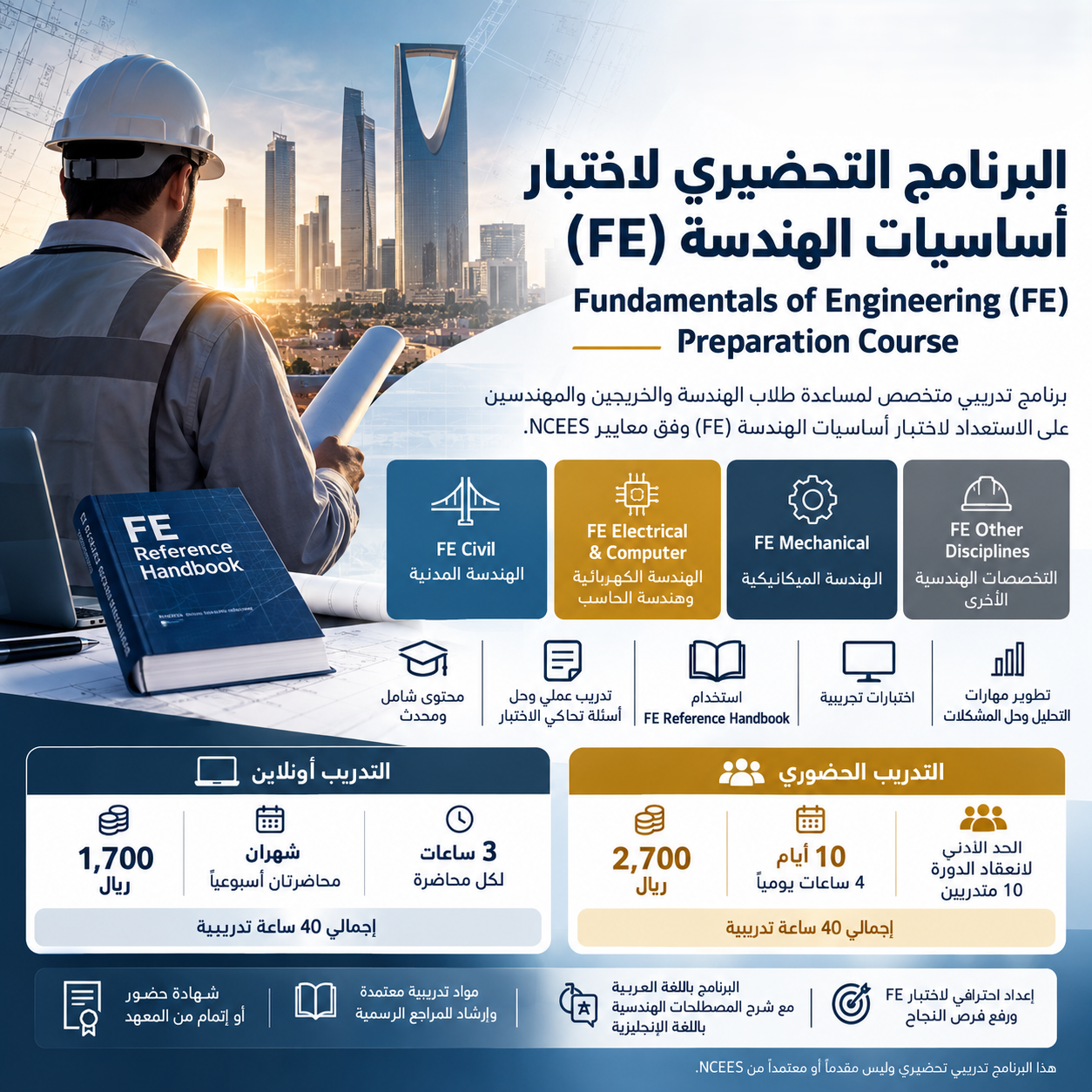
This training program is specifically designed to help engineering students, graduates, and engineers in Saudi Arabia prepare for the Fundamentals of Engineering (FE) Exam through a comprehensive review of fundamental engineering concepts, intensive practice with exam-style questions, an introduction to the exam structure and requirements, and practical training in the use of the FE Reference Handbook.
The program also helps engineers build a strong professional foundation and develop engineering analysis, problem-solving, time-management, and multidisciplinary engineering question-solving skills, supporting their professional development and readiness for advanced engineering credentials.
Program Description
The Fundamentals of Engineering (FE) Preparation Course is a specialized professional training program designed to support engineers and engineering students in Saudi Arabia who wish to strengthen their engineering knowledge and prepare for the Fundamentals of Engineering (FE) examination administered by the National Council of Examiners for Engineering and Surveying (NCEES) in the United States.
The program introduces participants to the standards and methodology of the FE Exam and provides them with the knowledge and skills required to address its various subject areas, including the fundamentals of mathematics, science, and engineering, with a strong focus on practical application and engineering problem-solving.
The program covers the exam topics according to the latest available NCEES specifications and provides participants with practical training in the effective use of the FE Reference Handbook, solving questions similar to those encountered in the actual exam, developing time-management skills, and applying strategies for the Computer-Based Testing (CBT) environment.
The program also provides engineers in Saudi Arabia with an opportunity to become familiar with an important international pathway for engineering professional development and credentialing, strengthen their technical and professional capabilities, and enhance their competitiveness in the local and international job markets.
It helps participants establish a strong engineering foundation that can serve as an initial step toward continued professional development and advanced engineering credentials, including Professional Engineer (PE), in accordance with NCEES requirements and relevant professional bodies in Saudi Arabia. المحتوى التعريفي الكامل لبرامج …
Program Objectives
The program aims to:
- Prepare engineers and engineering students for the FE Exam.
- Strengthen knowledge of engineering fundamentals and sciences related to the examination.
- Train participants to use the FE Reference Handbook effectively.
- Develop engineering analysis and problem-solving skills.
- Provide practice using questions that simulate the actual examination.
- Develop time-management skills and the ability to deal effectively with computer-based examinations.
- Support the professional development of engineers in Saudi Arabia according to international engineering standards.
Target Audience
The program is designed for:
- Engineering students in their final years of study.
- Engineering graduates.
- Engineers at the beginning of their professional careers.
- Engineers seeking to develop their professional qualifications.
- Engineers seeking to build an international professional career path and progress toward the PE stage in the future.
Learning Outcomes
By the end of the program, participants will be able to:
- Understand the professional pathway and preparation requirements for the FE and PE examinations according to NCEES systems and standards.
- Understand the structure of the FE or PE examination, registration and application procedures, and the nature of Computer-Based Testing (CBT).
- Review and apply engineering principles and fundamentals relevant to their discipline in accordance with the approved exam specifications.
- Use the NCEES Reference Handbook and permitted references effectively during the examination.
- Analyze engineering problems and select appropriate solution methodologies within the available time.
- Apply engineering concepts to questions that simulate the level and nature of the actual examination.
- Develop effective strategies for answering questions and managing time during the examination.
- Assess exam readiness through mock examinations, analyze results, and identify strengths and areas for improvement.
- Identify common mistakes in FE and PE examinations and develop methods to avoid them.
- Enhance technical competency, problem-solving skills, and exam preparedness.
- Improve scientific and professional readiness to take the FE or PE examination with greater confidence and competence.
- Understand the relationship between international professional credentials and the career path of engineers in Saudi Arabia in accordance with the requirements of the Saudi Council of Engineers (SCE) and other relevant authorities.
Admission Requirements
Applicants should meet the following requirements:
- Hold a bachelor’s degree in an engineering discipline or be a final-year engineering student for the FE program.
- Have an interest in taking the Fundamentals of Engineering (FE) or Professional Engineer (PE) examination.
- For the PE program, participants are preferably expected to have passed the FE Exam or meet the requirements of the licensing authority in the state in which they intend to apply.
- Commit to attending the training sessions and completing the required activities and assessments.
Training Tracks
The program provides specialized preparation according to the participant’s engineering discipline. Each track consists of 40 training hours.
1. FE Civil Engineering
Course Topics
- Introduction to FE Exam
- Mathematics & Statistics
- Ethics & Professional Practice
- Engineering Economics
- Statics
- Dynamics
- Mechanics of Materials
- Engineering Materials
- Fluid Mechanics
- Surveying
- Water Resources & Environmental Engineering
- Structural Engineering
- Geotechnical Engineering
- Transportation Engineering
- Construction Engineering
- FE Exam Preparation & Mock Exams
Training Hours
- Introduction to FE Exam — 1 Hour
- Mathematics & Statistics — 2 Hours
- Ethics & Professional Practice — 1 Hour
- Engineering Economics — 1 Hour
- Statics — 2 Hours
- Dynamics — 1 Hour
- Mechanics of Materials — 2 Hours
- Materials — 2 Hours
- Fluid Mechanics — 2 Hours
- Surveying — 2 Hours
- Water Resources & Environmental Engineering — 5 Hours
- Structural Engineering — 5 Hours
- Geotechnical Engineering — 5 Hours
- Transportation Engineering — 4 Hours
- Construction Engineering — 3 Hours
- FE Exam Preparation & Mock Exams — 2 Hours
Total: 40 Training Hours
2. FE Electrical & Computer Engineering
Course Topics
- Introduction to FE Exam
- Mathematics
- Probability & Statistics
- Ethics & Professional Practice
- Engineering Economics
- Properties of Electrical Materials
- Circuit Analysis
- Linear Systems
- Signal Processing
- Electronics
- Power Systems
- Electromagnetics
- Control Systems
- Communications
- Computer Networks
- Digital Systems
- Computer Systems
- Software Engineering
- FE Exam Preparation & Mock Exams
Training Hours
- Introduction to FE Exam — 1 Hour
- Mathematics — 3 Hours
- Probability & Statistics — 1 Hour
- Ethics & Professional Practice — 1 Hour
- Engineering Economics — 1 Hour
- Properties of Electrical Materials — 1 Hour
- Circuit Analysis — 4 Hours
- Linear Systems — 2 Hours
- Signal Processing — 2 Hours
- Electronics — 3 Hours
- Power Systems — 3 Hours
- Electromagnetics — 1 Hour
- Control Systems — 2 Hours
- Communications — 2 Hours
- Computer Networks — 1 Hour
- Digital Systems — 3 Hours
- Computer Systems — 2 Hours
- Software Engineering — 2 Hours
- FE Exam Preparation & Mock Exams — 4 Hours
Total: 40 Training Hours
3. FE Mechanical Engineering
Course Topics
- Introduction to FE Exam
- Mathematics
- Probability & Statistics
- Ethics & Professional Practice
- Engineering Economics
- Electricity & Magnetism
- Statics
- Dynamics, Kinematics & Vibrations
- Mechanics of Materials
- Material Properties & Processing
- Fluid Mechanics
- Thermodynamics
- Heat Transfer
- Measurements, Instrumentation & Controls
- Mechanical Design & Analysis
- FE Exam Preparation & Mock Exams
Training Hours
- Introduction to FE Exam — 1 Hour
- Mathematics — 2 Hours
- Probability & Statistics — 1 Hour
- Ethics & Professional Practice — 1 Hour
- Engineering Economics — 1 Hour
- Electricity & Magnetism — 2 Hours
- Statics — 3 Hours
- Dynamics, Kinematics & Vibrations — 4 Hours
- Mechanics of Materials — 4 Hours
- Material Properties & Processing — 3 Hours
- Fluid Mechanics — 4 Hours
- Thermodynamics — 4 Hours
- Heat Transfer — 3 Hours
- Measurements, Instrumentation & Controls — 2 Hours
- Mechanical Design & Analysis — 4 Hours
- FE Exam Preparation & Mock Exams — 1 Hour
Total: 40 Training Hours
4. FE Other Disciplines
Course Topics
- Introduction to FE Exam
- Mathematics
- Probability & Statistics
- Chemistry
- Instrumentation & Controls
- Engineering Ethics & Societal Impacts
- Safety, Health & Environment
- Engineering Economics
- Statics
- Dynamics
- Strength of Materials
- Materials
- Fluid Mechanics
- Basic Electrical Engineering
- Thermodynamics & Heat Transfer
- FE Exam Preparation & Mock Exams
Training Hours
- Introduction to FE Exam — 1 Hour
- Mathematics — 3 Hours
- Probability & Statistics — 2 Hours
- Chemistry — 2 Hours
- Instrumentation & Controls — 1 Hour
- Engineering Ethics & Societal Impacts — 2 Hours
- Safety, Health & Environment — 3 Hours
- Engineering Economics — 2 Hours
- Statics — 3 Hours
- Dynamics — 3 Hours
- Strength of Materials — 3 Hours
- Materials — 2 Hours
- Fluid Mechanics — 5 Hours
- Basic Electrical Engineering — 2 Hours
- Thermodynamics & Heat Transfer — 4 Hours
- FE Exam Preparation & Mock Exams — 2 Hours
Total: 40 Training Hours
Training Duration and Delivery Options
Online Training
Fee: SAR 1,700
Total Training Hours: 40 Hours
Duration: 2 Months
Schedule: 2 Lectures per Week
Lecture Duration: 3 Hours
In-Person Training
Fee: SAR 2,700
Total Training Hours: 40 Hours
Duration: 10 Days
Daily Training: 4 Hours per Day
Minimum Number of Participants: 10 Participants
Program Language
The program is delivered in Arabic, with engineering terminology explained in English, as the official examinations and references are in English.
Practical Exercises and Mock Exams
The program includes theoretical instruction, practical exercises, questions that simulate the actual examination, and mock exams.
Certificate
Upon completion of the program, participants receive a Certificate of Attendance or Completion from the Institute, subject to the Institute’s policies and program completion requirements.
Training Materials and References
Participants receive training materials approved by the trainer, along with guidance on the official references recommended for exam preparation.
Important Disclaimer
This is a training and exam preparation program designed to prepare participants for NCEES examinations. It is not a program offered or accredited by NCEES.
No training provider can guarantee success in the examination. The program is designed to enhance participants’ knowledge, readiness, and chances of success through structured training and intensive practice.