
Programme Overview
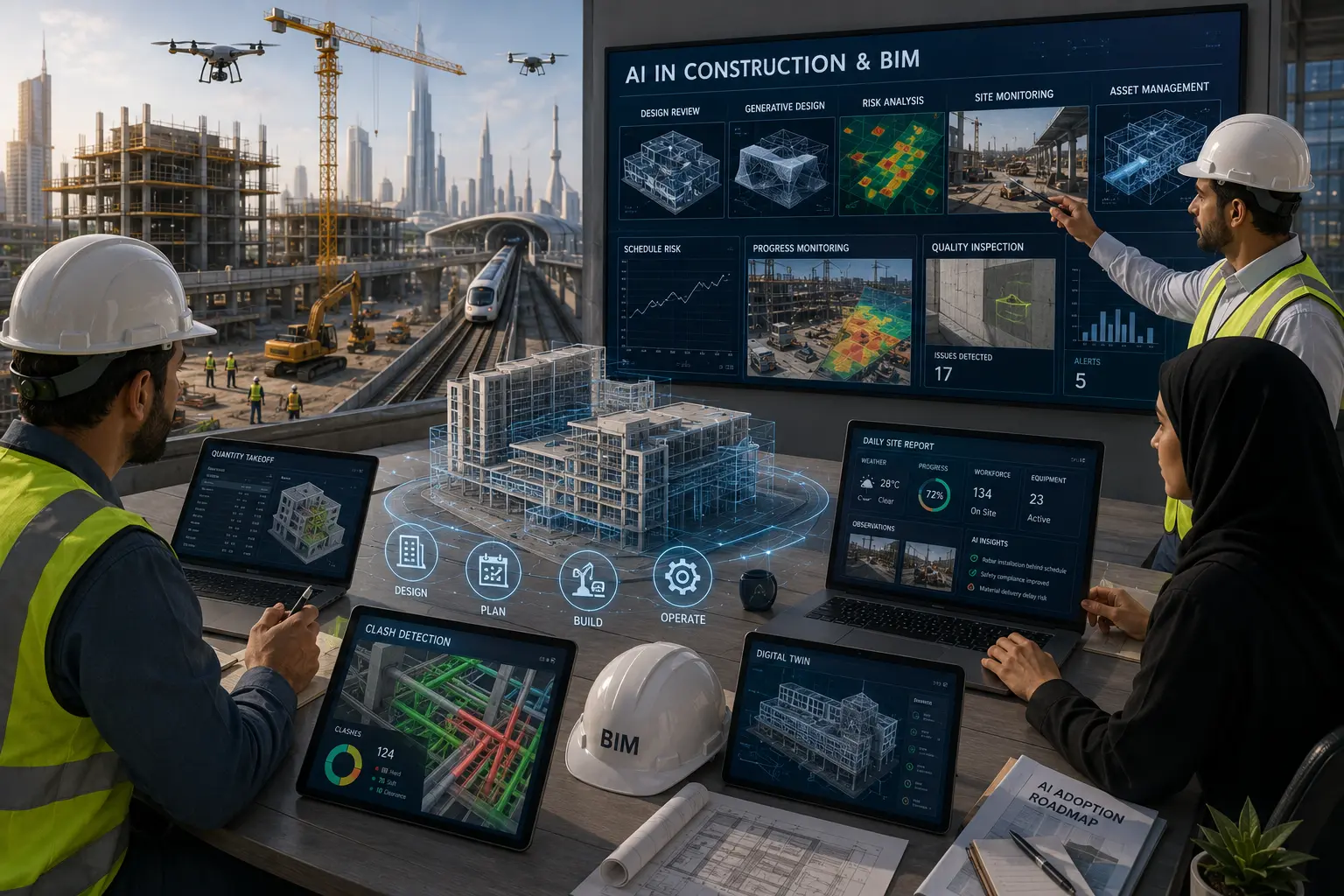
A two-day programme for construction and infrastructure professionals working across the project life cycle from design to commissioning. It covers how AI is reshaping design, planning, site management, quality control and asset management, with a focus on how AI integrates into Building Information Modelling (BIM) workflows and digital-twin environments. The content is grounded in the Saudi giga-project context — including NEOM, the Red Sea, Diriyah, Qiddiya and the Riyadh Metro — and the vast infrastructure programme under Saudi Vision 2030. The hands-on work uses BIM-embedded AI tools and realistic construction data.
Learning Objectives
By the end of this programme, participants will be able to:
- Describe how AI is reshaping construction, infrastructure and BIM practice across the project life cycle.
- Use AI tools for design review, quantity take-off, clash detection, planning, risk analysis and field reporting.
- Integrate AI into BIM workflows and digital-twin environments.
- Evaluate AI-based construction-technology vendors for fit, interoperability and data sovereignty.
- Recognise construction-specific AI risks, including safety-related failure modes and contractual implications.
- Apply SDAIA, the PDPL and sector-specific safety and quality requirements to AI use in construction.
Programme Content & Modules
Day 1: The construction landscape and AI in practice
How AI is reshaping the construction and infrastructure sector. Design automation, generative design, computer vision for sites, predictive planning and digital twins. The Saudi giga-project and infrastructure context. Where AI has matured in the sector and where it is still maturing.
Practical work with AI tools for design review, quantity take-off and clash detection, BIM-embedded assistants and field reporting. The essentials of generative design. The essentials of digital twins. A tour of AI-enhanced BIM, project-controls and site-management platforms.
Day 2: AI-supported delivery and responsible practice
Using AI for schedule-risk analysis, computer-vision progress monitoring, safety monitoring, quality inspection and field reporting. Combining AI output with engineering and construction judgement. A group exercise on a realistic construction scenario.
Safety, liability and professional responsibility when AI enters the construction loop. Contractual and insurance implications. Governance of BIM, site and asset data. Alignment with SDAIA and sector regulation. Data-sovereignty considerations for giga-project IP. Applied capstone project: each participant designs an AI-adoption plan for one construction process.
Suggested Duration
Two training days.
Target Audience & Prerequisites
Target audience: Construction managers, site engineers, project controllers, BIM managers and coordinators, quantity surveyors, design managers, commissioning engineers and construction managers working on giga-projects, infrastructure, buildings, facilities and industrial plants. The programme suits contractors, owners, consultants and regulators.
Prerequisites: Practical experience in construction or infrastructure. Basic familiarity with BIM is helpful but not required. No prior background in AI or programming is required. A laptop is required for the hands-on sessions.